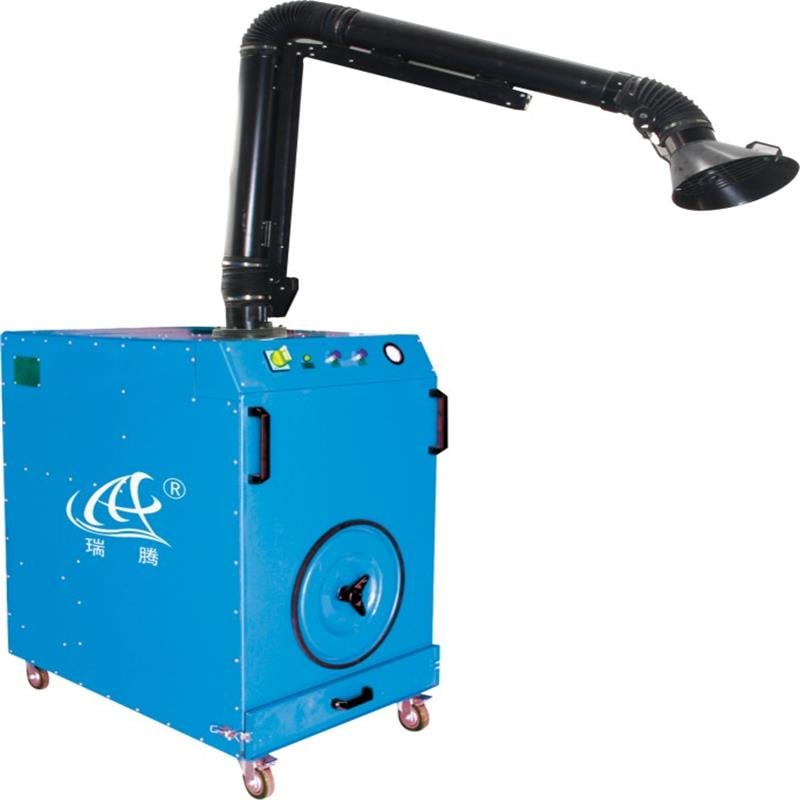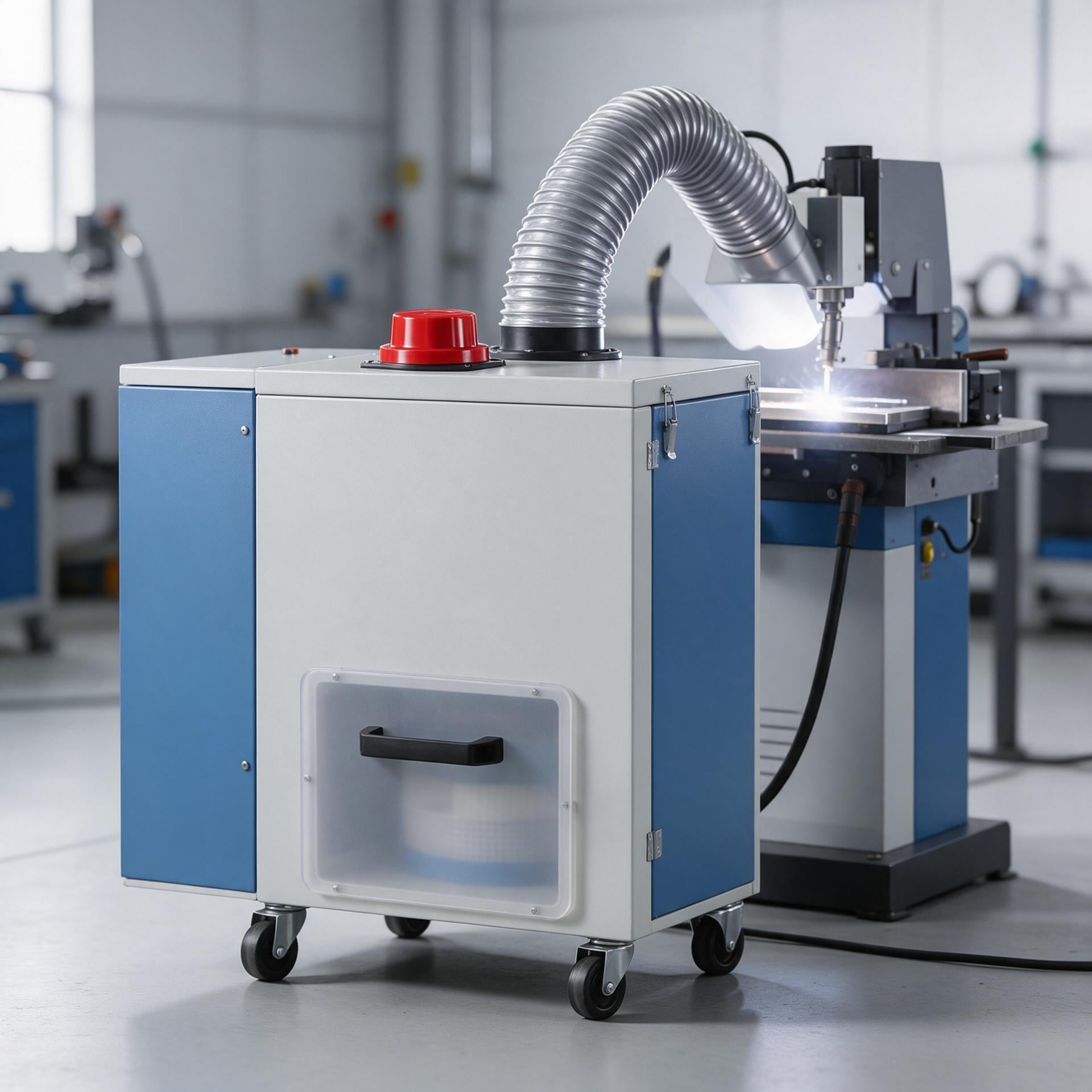
A portable fume dust collector brings extraction to the work rather than forcing the work to a fixed station. It is a compact unit on wheels, usually with a flexible hose or arm that can be positioned near the source of smoke. In workshop use where weld jobs change location, or where maintenance tasks move around the floor, this flexibility is the whole point. Buyers often ask whether a mobile unit can replace a fixed system; the honest answer is that it serves a different need. Understanding when to use a portable fume dust collector helps you decide whether it is the right tool or a useful supplement to existing extraction.
Mobile extraction suits workshop use that is intermittent, shifting or hard to reach with fixed ductwork. Typical examples include repair welding, small batch fabrication, soldering at different benches and on site maintenance. In these cases a fixed hood would leave much of the shop uncovered, while a portable fume dust collector can move to the task. It also suits temporary setups and rented spaces where permanent installation is not practical. If your process generates smoke at a stable location and high volume, a fixed system is usually more efficient. The decision rests largely on how much the work moves.
A unit that moves easily must also stay put when in use. Locking casters are the feature that makes this possible: once the portable fume dust collector is positioned, the wheels are locked so it cannot drift when the hose is adjusted or someone bumps past. This is a small detail with real safety value, because an unstable unit can pull the capture opening away from the plume. Check that the locking casters can be engaged quickly and that they hold on a typical workshop floor. Stability also depends on the unit being level, so set it on even ground before starting work.
Where you place the unit matters as much as the unit itself. Set the portable fume dust collector close enough that the flexible hose reaches the work without being stretched tight, but not so close that it blocks movement. Route the hose and power cable so they do not cross walkways or create a trip hazard, a point often overlooked in busy shops. Avoid sharp bends in the flexible hose, since they reduce airflow at the hood. Before each use, confirm that the capture opening faces the plume and that the hose is clear of obstructions. Treat workshop use of a mobile unit as a routine that protects both air quality and safe movement.
Consider an anonymous repair workshop, a typical workshop use for mobile extraction, that handled welding jobs at different points on the floor. A fixed extraction arm could not reach every position, so smoke often lingered near the operator. The team introduced a portable fume dust collector with locking casters and a flexible hose, and made a simple rule: park the unit level, lock the wheels and route the hose away from the walking path before striking an arc. Smoke near the breathing zone reduced because capture was finally close to the source. No change was made to the building. The case shows that mobile fume extraction works when setup discipline matches the equipment.
A short routine makes workshop use of a portable unit reliable. Roll the unit to the work, set it level and engage the locking casters. Uncoil the flexible hose fully, then shape it so the hood sits near the plume without crossing a walkway. Check that the cable is out of the traffic path and that nothing can snag it. Switch on and confirm airflow at the hood before welding begins. When the job moves, repeat the routine rather than dragging the unit with the hose attached. Treat these steps as part of workshop practice, not optional advice.
A portable fume dust collector is not a universal answer. In workshop use it covers one station at a time, so several simultaneous weld jobs may need more than one unit. Its capacity is usually smaller than a central system, and the filter will need attention as it loads. The unit must be positioned correctly every time, which depends on operator discipline; if the hose is left across an aisle, convenience becomes a hazard. For high volume or continuous smoke, a fixed system remains the better choice. Used within its limits, mobile fume extraction is a practical way to protect operators in changing workshop conditions.
Question one: When should I choose a portable fume dust collector?
Answer: For workshop use with welding or soldering jobs that move around the shop, or when a fixed duct run is impractical. It covers one station at a time and suits intermittent work best.
Question two: Why do locking casters matter?
Answer: They keep the unit stationary once positioned, so the hose stays aimed at the plume and the unit cannot drift when bumped. Lock them after setting the collector level.
Question three: How should the hose be routed?
Answer: Keep it long enough to reach the work, avoid sharp bends and never run it across a walkway. Route the cable clear of traffic as part of safe mobile fume extraction.
 Hot News
2026-11-21
2026-11-21
2026-11-21
2026-11-21
2026-11-21
2026-11-20
Renhe focuses on air filter cartridge, gas turbine air filter, Pleated Filter Media, industrial dust, Our main products have been recognized as high-tech products in Jiangsu Province, famous trademarks in Wuxi City, and CE certification.
NO. 31 Xingyuan Road, Jiefang Industrial Park, Gushan Town, Jiangyin City, Jiangsu Province, China (214414)
Copyright © 2024 Jiangsu Renhe Environmental Equipments Co., Ltd Privacy Policy
 EN