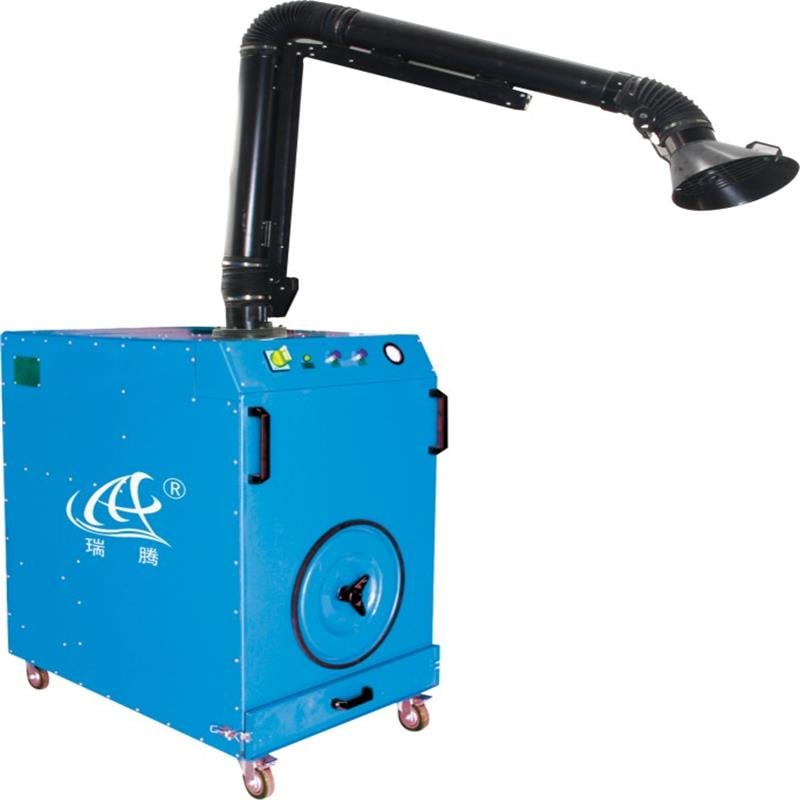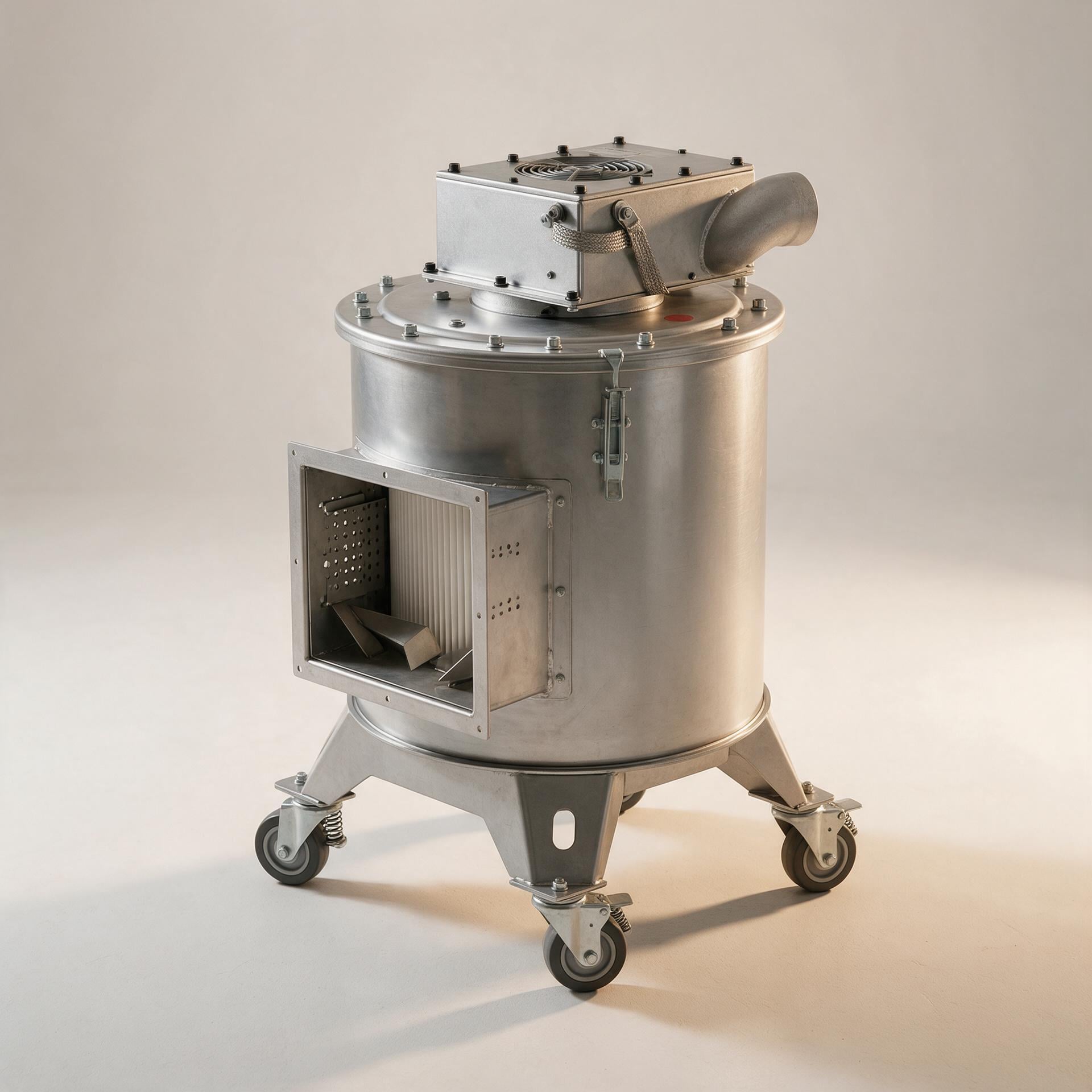
A single spark from a welding arc is harmless in open air. Inside a duct, the same particle can travel into a filter chamber where fine dust is suspended, and that combination is a recognised fire risk. This is why a welding fume extractor should be evaluated as a complete safety system rather than as a fan with a filter attached. Buyers who focus only on airflow often miss the stage that handles hot particles before they ever reach the media, and welding fume collection suffers as a result. A built in spark arrestor addresses that gap by intercepting and cooling hot particles at the front of the system. Spark arrestor fire safety begins here, long before the airstream reaches the filters. Understanding this role helps you ask better questions during specification, especially where one unit serves several stations.
Think of a built in spark arrestor as a preconditioning stage. Its job is to remove or cool the hottest fragments in the airstream before the air reaches filter media that may carry a dust layer. In practical terms, a built in spark arrestor adds a deliberate separation step upstream of the filters, so the welding fume extractor does not depend on the media to survive direct spark impact. The mechanical details vary with the process and should be confirmed with the supplier rather than assumed from a catalogue image. What matters for the buyer is the principle: hot particles should lose their energy ahead of the filtration zone. That principle is central to spark arrestor fire safety and should appear in the written system description you receive.
Spark arrestor fire safety is not delivered by one component alone. It depends on how the hood, duct, separation stage, filter media, and cleaning method work together. Anti-static media, for example, is used to conduct electrostatic charge away rather than letting it accumulate, and the collector frame must be bonded to a reliable earth point. A welding fume dust collector handling combustible metal dust should therefore be reviewed as an assembly: where sparks are generated, how far they travel, and what stands between them and the dust layer. Suppliers should explain the safety logic in plain language. If the answer stops at the claim that the filter catches everything, treat that as an incomplete specification for a welding fume extractor.
Not every welding operation puts the same load on a welding fume extractor. Manual arc welding at fixed benches produces a predictable plume, while large components with moving weld points demand distributed capture. The welding fume collection arrangement changes accordingly: hood position, duct length, and whether several stations share one unit all affect how hot particles behave. A welding fume dust collector specified for a high-deposition process needs more attention to upstream separation than one serving light fabrication. Ask which RH/HY welding fume dust collector configuration suits your station layout and request the airflow calculation behind the recommendation. Welding fume collection is most effective when capture is close to the arc and the duct path does not let particles settle.
A multinational heavy-industry enterprise producing tower and crawler cranes faced a familiar constraint: its boom line handled large carbon steel components whose welding points shifted along the workpiece. The plant used MAG gas-shielded welding and argon arc welding, so fume generation was not tied to one fixed station. The adopted solution was distributed blow-and-suction collection, with blow outlets around four metres high and suction inlets around nine metres, creating a local downward circulation over the work zone. In such a layout, each welding fume extractor must tolerate sparks generated across a wide area. The lesson for a buyer is that spark arrestor fire safety depends on capture geometry as much as on the filter chamber, and that a built in spark arrestor should be specified together with the hood arrangement rather than added as an afterthought.
Four checks keep a welding fume extractor specification honest. First, confirm the upstream separation stage and how it is cleaned, because a spark handling stage that is never serviced will stop protecting the filters. Second, review grounding and anti-static provisions for the duct and collector frame. Third, match airflow to the number of simultaneous welding stations rather than to an average shift. Fourth, confirm that filter changes can be done without spreading collected dust back into the shop. Spark arrestor fire safety also depends on keeping the system clean on a defined schedule. A welding fume extractor is judged by its behaviour across a full production cycle, not by a single demonstration. Request material guidance and verify test documents before approving the layout.
Question one: Is a built in spark arrestor the same as a fire suppression system?
Answer: No. A built in spark arrestor is a preventive upstream measure that removes or cools hot particles before the filter zone. It does not replace suppression systems, and a welding fume extractor still needs a safety plan with both layers.
Question two: Which welding processes deserve the most attention for a welding fume dust collector?
Answer: Processes with visible spatter and fine combustible dust deserve the closest review. In the crane plant example, MAG and argon arc welding on large carbon steel parts required distributed capture rather than one fixed hood.
Question three: Where should a welding fume extractor be positioned?
Answer: Capture should sit close to the arc, with a short duct run that discourages particles from settling. For moving weld points, distributed collection is usually more practical than a single distant inlet, and welding fume collection should be planned around the real work pattern.
 Hot News
2026-11-21
2026-11-21
2026-11-21
2026-11-21
2026-11-21
2026-11-20
Renhe focuses on air filter cartridge, gas turbine air filter, Pleated Filter Media, industrial dust, Our main products have been recognized as high-tech products in Jiangsu Province, famous trademarks in Wuxi City, and CE certification.
NO. 31 Xingyuan Road, Jiefang Industrial Park, Gushan Town, Jiangyin City, Jiangsu Province, China (214414)
Copyright © 2024 Jiangsu Renhe Environmental Equipments Co., Ltd Privacy Policy
 EN