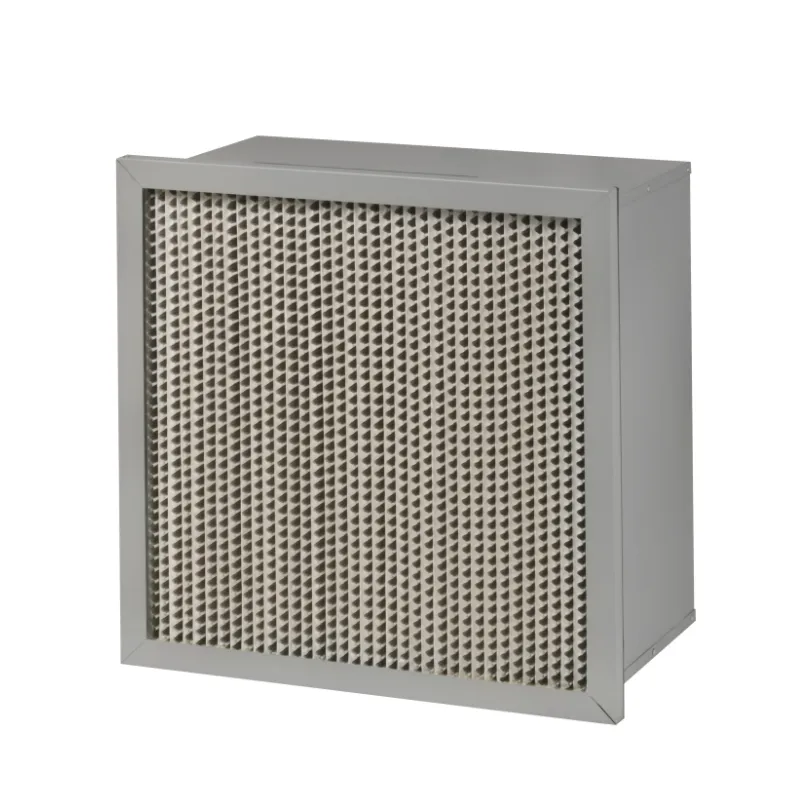
A fan filter unit FFU that hangs crooked in a ceiling grid will leak around its frame and deliver uneven airflow to the room below. That is why installers treat a fan filter unit FFU as both a mechanical load and an air handling device. Before you lift a single unit, you need a sound grid, a clear support plan, and a repeatable leveling method. This guide walks through the practical steps of ceiling grid installation for a fan filter unit FFU and explains where mistakes usually happen.
A T-bar ceiling grid is not automatically strong enough to carry a powered filter unit. Verify the grid gauge, the hanger spacing, and the point where the building structure takes the load. Many projects add an independent support frame above the T-bar ceiling grid so the weight does not rest on lightweight tees alone. Walk the grid and look for bent tees or loose clips before any fan filter unit FFU is placed. Confirm that the T-bar ceiling grid is square and level at the corners; a twisted grid makes leveling almost impossible later. If the ceiling grid installation is for a cleanroom, document the grid height and the direction of the tees.
A fan filter unit FFU is bulky and its motor and filter add real weight. Use two people or a lifter, and keep the unit boxed until it is over its final position. Protect the filter face from knocks, because a damaged media pack defeats the purpose of the unit. Set a clear zone below so nobody stands under a suspended fan filter unit FFU during placement. Confirm that power is isolated at the circuit before any wiring is joined. Safe ceiling grid installation is mostly about controlling the load and the sequence: support first, place second, connect third. Rushing the order is how a fan filter unit FFU ends up tilted or dropped.
Lower the fan filter unit FFU onto the tees so the frame sits evenly on all four edges. Do not let one corner take the weight first. Leveling starts with the frame, not with the internal fan. Place a spirit level across the frame in two directions and adjust the hangers a little at a time. A fan filter unit FFU that is out of level by a few millimetres can show a visible gap at the gasket. Recheck leveling after the gasket is compressed, because the seal changes the seat. In a cleanroom ceiling, a seal gap allows unfiltered air to bypass the media and undermines the room class. Slow, small adjustments beat a single large correction.
Once leveling is stable, check the gasket or sealant around the frame. The joint between the fan filter unit FFU and the tees is a common leakage path. Follow the supplier guidance for the seal type that suits your cleanroom ceiling. Connect power according to the wiring diagram and confirm the fan rotation before closing the access panel. After startup, measure airflow and pressure across the face of the fan filter unit FFU. A healthy unit shows even airflow across the panel; a tilted or poorly seated one shows a dead zone. Record the readings so you can compare them at the next check. This verification closes the loop on the whole ceiling grid installation.
Consider a facility fitting a cleanroom ceiling over an electronics assembly area. The contractor had installed a standard T-bar ceiling grid, but the units were heavier than expected and the tees deflected slightly. Rather than forcing the panels, the team added an independent support rail above the grid and repeated leveling on every fan filter unit FFU. The result was a flat row with consistent gasket compression and no visible bypass. A supplier with long filtration experience, such as Jiangsu Renhe, can confirm the unit weight and the recommended support approach before delivery, so the ceiling grid installation is planned around the real load rather than a guess. This is a case where asking about support details upfront saves a full rework later.
Buyers often choose between hanging a fan filter unit FFU directly from the grid and adding a dedicated support frame. Direct mounting is simpler but depends entirely on the strength of the T-bar ceiling grid. A dedicated frame costs more and takes headroom, but it isolates the load and makes leveling easier to hold over time. For a cleanroom ceiling with many units, the frame also lines up the panels so each fan filter unit FFU sits at the same height. Put the two options in a written comparison with weight, headroom, and service access. Choose the one that lets you keep the seal compressed without stressing the grid.
Question one: Can a fan filter unit FFU hang directly from a T-bar ceiling grid?
Answer: Sometimes, if the grid gauge and hangers are rated for the load. Many cleanroom projects add independent support above the T-bar ceiling grid to avoid deflection and keep leveling stable.
Question two: Why does leveling matter so much?
Answer: An out of level unit leaves a gap at the gasket, so unfiltered air bypasses the filter. Good leveling protects the cleanroom ceiling performance and keeps airflow even across the fan filter unit FFU.
Question three: What should be checked at startup?
Answer: Confirm power isolation, fan rotation, gasket compression, and airflow across the face. Record the readings so the ceiling grid installation can be compared at the next service visit.
 Hot News
2026-11-21
2026-11-21
2026-11-21
2026-11-21
2026-11-21
2026-11-20
Renhe focuses on air filter cartridge, gas turbine air filter, Pleated Filter Media, industrial dust, Our main products have been recognized as high-tech products in Jiangsu Province, famous trademarks in Wuxi City, and CE certification.
NO. 31 Xingyuan Road, Jiefang Industrial Park, Gushan Town, Jiangyin City, Jiangsu Province, China (214414)
Copyright © 2024 Jiangsu Renhe Environmental Equipments Co., Ltd Privacy Policy
 EN