
 EN
EN
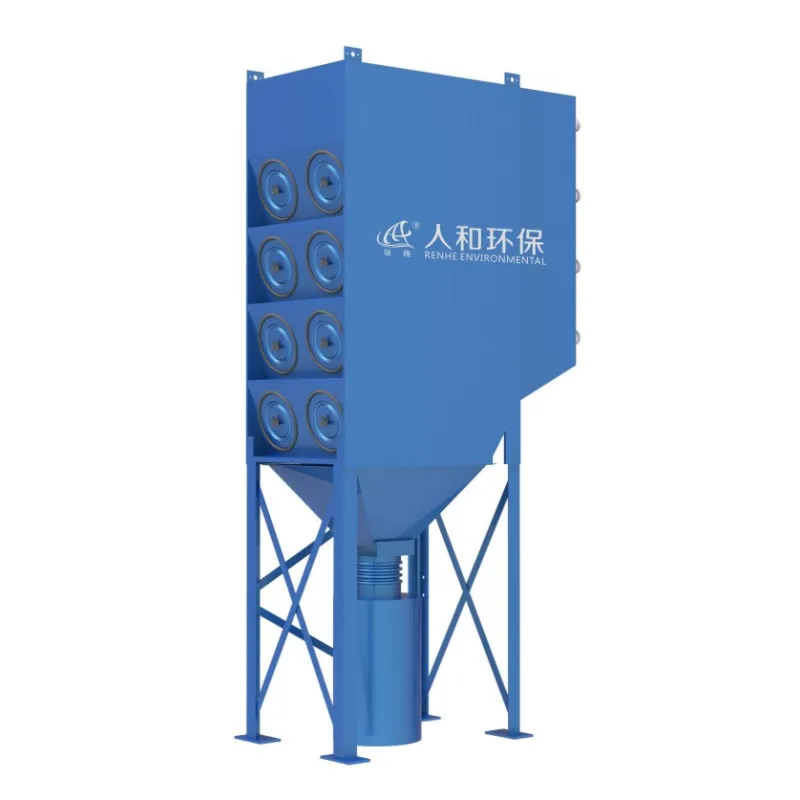
Lower Energy Consumption: How Cartridge Dust Collector Reduces Fan Power Demand
The Pressure Drop Advantage: ≤2.5" w.c. vs. 6–8" w.c. in Baghouses
A cartridge dust collector operates with a significantly lower pressure drop—typically ≤2.5 inches water column (w.c.) at design airflow—compared to traditional baghouses, which commonly run at 6–8" w.c. This advantage arises from the pleated media design, delivering 2–3 times more filtration surface area within the same footprint and reducing face velocity and airflow resistance. Since fan power demand scales directly with pressure drop, maintaining a stable, low baseline (e.g., 2.2" w.c. instead of 7" w.c.) cuts energy use substantially: industry data shows each 1" w.c. reduction lowers annual fan energy consumption by 5–7% in a typical 20,000 CFM system. Crucially, the cartridge’s consistent low resistance delays the need for compensatory fan speed increases during dust cake buildup—keeping operating costs predictable and low over time.
Energy Savings in Practice: 25–35% Less kWh Use with IE3 Motors and VFDs
Pairing a cartridge dust collector with high-efficiency IE3 motors and variable frequency drives (VFDs) unlocks measurable energy reductions. Unlike fixed-speed fans that run at full RPM regardless of actual demand, a VFD—controlled by a static pressure sensor—modulates motor speed to sustain required airflow as filter resistance changes. With clean filters and a pressure drop of just 1.5" w.c., the VFD can operate the motor at 70–80% of full speed, slashing kWh draw. Field data across multiple industrial sites confirms that this integration reduces total fan energy use by 25–35% versus standard fixed-speed, standard-efficiency systems. For a plant running a 30 HP dust collector two shifts daily, that translates to $2,800–$4,200 in annual electricity savings at average industrial rates. The cartridge’s inherently low pressure drop is foundational here—it enables the VFD to remain in its most efficient operating range longer than possible with higher-resistance alternatives.
Real-World Validation: 31% Annual Fan Energy Reduction at Changzhou Automotive OEM
A Changzhou-based automotive parts manufacturer replaced its aging baghouse with a cartridge dust collector equipped with IE3 motors and VFD control. Processing grinding and welding fumes at 18,000 CFM, the facility recorded 92,400 kWh of annual fan energy use pre-retrofit. Post-installation, the new system maintained a steady 2.2" w.c. pressure drop and consumed only 63,800 kWh per year—a 31% reduction. Eliminating damper throttling and reducing compressed air usage for pulse cleaning further enhanced efficiency. This outcome reflects broader industry validation: a well-engineered cartridge dust collector can cut fan energy costs by roughly one-third, delivering a payback period under two years when combined with reduced maintenance and filter replacement expenses.
Regulatory Risk Mitigation: Sub-Micron Filtration Compliance with Cartridge Dust Collector
Tightening Standards: GB 37822 (China) and EU IED Enforcement on PM2.5/PM10
Global environmental regulations are shifting decisively toward sub-micron particulate control—specifically PM2.5 and PM10—with enforceable limits now embedded in China’s GB 37822 (2019) and the EU’s Industrial Emissions Directive (IED). These standards no longer treat dust collection as a general housekeeping function; they define it as a core compliance obligation with direct financial consequences—including fines, production curtailments, or mandated retrofits. Key enforcement trends include:
- Lower Emission Caps: Jurisdictions increasingly impose limits below 10 mg/Nm³, with ultra-low targets under 5 mg/Nm³ gaining traction.
- Particle-Specific Requirements: Restrictions now explicitly target respirable fractions (PM2.5), demanding filtration capable of capturing sub-micron aerosols.
- Verification Mandates: Regulators require continuous emission monitoring, auditable performance records, and documented verification of filter integrity and efficiency.
This evolution transforms dust collection from an operational cost into a strategic risk management tool—where technology choice directly affects regulatory standing and license-to-operate.
Nanofiber-Coated Cartridges Deliver 99.9% Efficiency at 0.3 µm—Stabilizing Emissions & Avoiding Penalties
Nanofiber-coated filter cartridges deliver the precision filtration needed to meet these evolving requirements. Unlike conventional cellulose or polyester media—which rely on deep-loading and exhibit variable efficiency as dust penetrates the substrate—nanofiber coatings form a uniform, fine-pore surface layer that captures 99.9% of particles at 0.3 µm. Certified to MERV 15 performance, this technology provides stable, repeatable emissions output—critical for regulatory assurance. The result is dramatically reduced emissions variability, minimizing exposure to non-compliance penalties. For example, the Changzhou automotive OEM cited earlier achieved both 31% fan energy reduction and compliant PM2.5 emissions—demonstrating how advanced cartridge design simultaneously addresses efficiency and governance objectives without trade-offs.
Predictive Maintenance Intelligence: Extending Cartridge Life and Cutting Unplanned Downtime
From Reactive to Predictive: Smart ΔP Monitoring and AI-Driven Service Life Forecasting
Predictive maintenance transforms cartridge dust collector upkeep from reactive troubleshooting into proactive, data-driven planning. Instead of relying on calendar-based replacements or run-to-failure practices—which lead to either premature cartridge discard or unplanned shutdowns—smart differential pressure (ΔP) sensors continuously track real-time filter loading. Coupled with AI algorithms that analyze ΔP trends alongside airflow velocity and dust load patterns, these systems forecast remaining service life with high accuracy. Facilities using this approach report up to 50% less unplanned downtime and 25–30% lower overall maintenance costs. By scheduling changes only when conditionally justified, operations extend cartridge life, stabilize throughput, and eliminate emergency repair costs.
TCO Impact: 2.3× Longer Cartridge Service Life vs. Time-Based Replacement Schedules
Time-based replacement schedules routinely discard cartridges with substantial remaining capacity—driving up material, labor, and disposal costs. Predictive maintenance eliminates this waste: by triggering replacements based on actual ΔP thresholds rather than arbitrary timelines, it extends average cartridge service life by 2.3× compared to fixed calendar plans. This directly reduces annual filter expenditures by more than half, while also lowering technician workload, waste handling volume, and administrative overhead. When integrated into a broader TCO framework—including energy savings and compliance stability—the 2.3× life extension delivers rapid ROI and contributes meaningfully to budget predictability.
Total Cost of Ownership and ROI: Quantifying Environmental Governance Savings with Cartridge Dust Collector
A cartridge dust collector’s financial value lies not in its sticker price, but in its lifetime cost profile. Procurement accounts for only 30–40% of total expenditure; energy, maintenance, and consumables dominate long-term outlays. Industry data illustrates this distribution:
| Cost Factor | Percentage of Total Cost |
|---|---|
| Initial Purchase | 30–40% |
| Installation | 10–20% |
| Energy Consumption | 20–30% |
| Maintenance | 15–25% |
| Filter Replacement | 5–15% |
Source: Industry expenditure data, 2024.
When engineered with advanced nanofiber cartridges and intelligent controls, all major cost drivers shrink. Verified annual savings across 200+ facilities fall into four key categories:
| Benefit Category | Annual Value Range | ROI Contribution |
|---|---|---|
| Energy Savings | $8,000–$45,000 | 35–50% |
| Filter Cost Reduction | $5,000–$20,000 | 15–25% |
| Maintenance Savings | $3,000–$15,000 | 10–20% |
| Compliance Avoidance | $2,000–$50,000 | 15–35% |
Source: Industry analysis, 2023.
Energy savings—driven by ≤2.5" w.c. pressure drop, IE3 motors, and VFDs—consistently deliver the largest ROI share. One facility realized a $7,400 annual energy saving after switching to a cartridge system (case study, 2023). Filter replacement intervals extended 2.3× beyond timed baghouse schedules, cutting both material and labor costs. Critically, regulatory risk mitigation avoids OSHA dust exposure violation fines averaging $47,000 per incident (OSHA, 2023) and prevents cascading losses from forced downtime. Additional benefits compound value: facilities report 34% fewer workplace injuries and 28% lower equipment replacement costs (industry performance study, 2023); a metal fabricator reduced product rework by $67,000 annually post-upgrade (industry report, 2023). The cumulative effect is a typical payback period of 12–24 months—with every subsequent dollar of environmental governance savings flowing directly to net profit.
FAQ
What is the main benefit of cartridge dust collectors over traditional baghouses? Cartridge dust collectors offer lower pressure drop, resulting in reduced fan energy consumption and enhanced efficiency.
How do IE3 motors and VFDs contribute to energy savings? These technologies enable motor speed modulation based on airflow demand, which significantly lowers kWh usage.
Can cartridge dust collectors meet PM2.5 and PM10 regulatory standards? Yes, they can with advanced nanofiber-coated filters that achieve 99.9% efficiency at 0.3 µm.
How does predictive maintenance improve cartridge service life? Predictive systems monitor ΔP and forecast service life, reducing waste and extending filter longevity by 2.3×.
What factors influence TCO for a cartridge dust collector? Energy, maintenance, and filter replacement costs dominate total cost of ownership, while initial purchase accounts for just 30–40%.
Table of Contents
- Lower Energy Consumption: How Cartridge Dust Collector Reduces Fan Power Demand
- Regulatory Risk Mitigation: Sub-Micron Filtration Compliance with Cartridge Dust Collector
- Predictive Maintenance Intelligence: Extending Cartridge Life and Cutting Unplanned Downtime
- Total Cost of Ownership and ROI: Quantifying Environmental Governance Savings with Cartridge Dust Collector