
 EN
EN
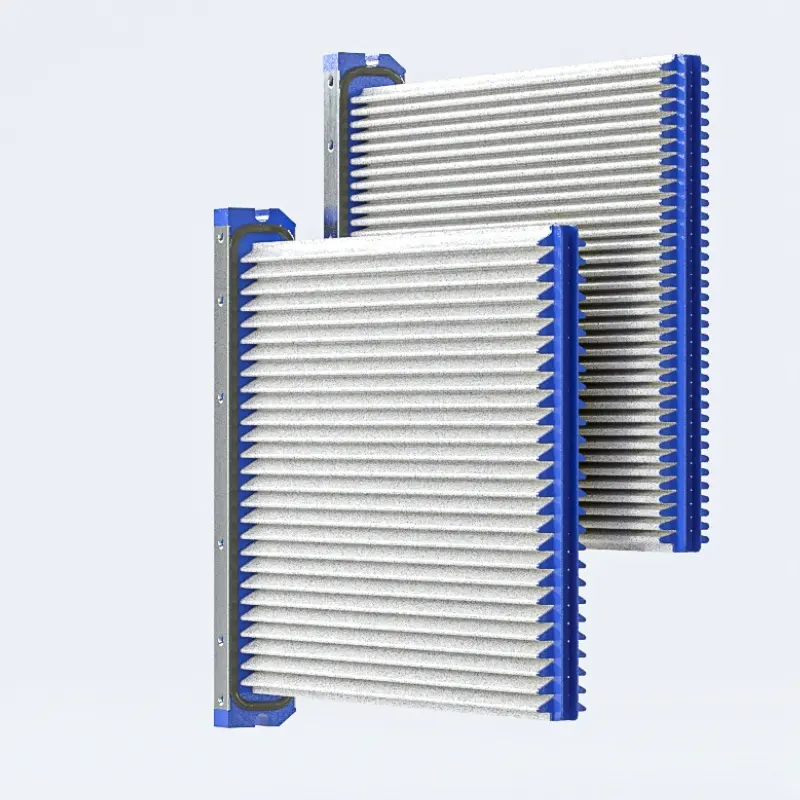
How Pleated Design Increases Surface Area and Dust Holding Capacity
Pleat geometry fundamentals: spacing, depth, and angle effects on effective filtration area
The pleated filter cartridge maximizes dust holding capacity by folding media into a three-dimensional structure—dramatically expanding the surface available for particle capture within a fixed volume. Three geometric parameters define this advantage: pleat spacing, depth, and angle. Wider spacing prevents premature inter-pleat dust bridging, keeping more media open to airflow. Greater pleat depth extends the path length, allowing a single cartridge to pack several square meters of material into a compact housing. The pleat angle—typically between 0° and 60°—controls how air enters the valleys; an optimized angle ensures uniform flow distribution across the entire pleat flank, eliminating dead zones where dust would accumulate unused. Research shows that stable structural parameters—such as a bending angle below 60° and a bending-portion ratio under 0.5—maintain consistent filtration efficiency throughout the loading cycle. Together, deeper, moderately angled pleats with adequate spacing strike the optimal balance between high effective area and manageable pressure drop—laying the foundation for superior dust retention.
Quantifying the advantage: 3×–5× more surface area vs. flat-sheet filters — direct impact on dust loading capacity
A pleated filter cartridge delivers three to five times the filtration area of a flat-sheet filter occupying the same footprint. This geometric expansion directly increases dust loading capacity: more media means more space for particles to be captured before pressure drop reaches its terminal limit. In practice, a pleated element holds 2–4 times more dust than a non-pleated counterpart while raising initial resistance by only 10–15 Pa. Crucially, the benefit extends beyond surface area—the folded structure enables true depth filtration, where particles penetrate and lodge within multiple layers of the media rather than forming a restrictive surface cake. Field data from industrial dust collection systems confirm that operators achieve 42% longer service intervals after switching to pleated cartridges—a direct reflection of enhanced surface area and depth-loading performance.
Dust Holding Mechanism: Depth Filtration and Particle Entrapment in Pleated Media
Pleat count and depth optimization: balancing dust capacity with pressure drop (ΔP)
A pleated filter cartridge achieves exceptional dust holding capacity not just through increased surface area—but by transforming the full media thickness into an active capture zone. Depth filtration traps particles within the tortuous fiber labyrinth, rather than solely at the surface. Pleat count and depth determine how much dust can be stored before ΔP becomes unacceptable. More pleats increase media area, but if spacing is too tight, early inter-pleat bridging blocks airflow and spikes ΔP prematurely. Deeper pleats extend the retention path yet may elevate initial resistance. Industrial optimization studies show that a 50% increase in pleat count can lift dust holding capacity by ~40%—but only when pleat spacing remains at least 3–4 times the media thickness; otherwise, ΔP may rise 15–20% at the same dust load. Surface treatments further influence this balance: adding a nanofiber layer, for example, raises initial ΔP by over 35% while halving fine-particle penetration depth—demonstrating that even minor media modifications require recalibration of pleat geometry. The ideal configuration uniformly distributes captured dust across the media depth, preventing both early surface blinding and excessive channeling—maximizing usable service life.
Synergistic capture: how pleats enable multi-layer particle entrapment across the media thickness
Pleats convert a flat sheet into a three-dimensional capture network, leveraging multiple entrapment mechanisms in synergy. As contaminated air enters the pleat valley, larger particles are mechanically strained at the outer surface, while smaller ones follow the tortuous flow deeper into the media. There, diffusion and Brownian motion cause ultrafine particles to collide with fibers and adhere—a process enhanced by longer residence time. The pleated structure creates a graded capture effect: coarser upstream layers trap bulk particulate, protecting downstream finer layers for sub-micron retention. This multi-layer, depth-wise loading prevents rapid surface cake formation and instead distributes dust throughout the entire media thickness. By terminal ΔP, contaminants may reside up to 2.5 mm from the surface—nearly double the loading depth of a non-pleated depth filter of identical thickness. Combined surface sieving, depth entrapment, and adsorptive forces—including van der Waals, electrostatic, and hydrogen bonding—ensure high efficiency without sacrificing dust holding capacity, making the pleated filter cartridge a robust solution for applications demanding long service intervals and low operating cost.
Pleated Filter Cartridge vs. Non-Pleated: Real-World Efficiency, Lifespan, and Cost Performance
Case evidence: 42% longer service intervals in industrial dust collectors using pleated filter cartridge
In heavy-duty industrial dust collection, switching to pleated filter cartridges has delivered measurable operational gains. A 2022 field study across multiple manufacturing facilities found that these cartridges extended service intervals by 42% compared to conventional bag filters. The extended lifespan resulted directly from the high surface area and depth-loading design, which trapped more dust without premature clogging. Maintenance teams reduced filter changeouts by nearly half—cutting labor hours and disposal volumes. Stable airflow resistance over time also lowered fan energy consumption. This real-world evidence confirms that pleated geometry improves not only filtration efficiency but also delivers tangible cost savings through fewer replacements, less downtime, and reduced energy use.
Advanced Engineering Enhancements for Pleated Filter Cartridge Performance
Nanofiber coatings and gradient-density media: boosting dust holding capacity without increasing ΔP
Advanced material engineering is elevating pleated filter cartridge performance. Applying a nanofiber coating to the media surface creates a fine, web-like layer that captures submicron particles at the surface—preventing deep embedding and preserving open airflow paths. As a result, dust holding capacity increases without a sharp rise in pressure drop (ΔP). Similarly, gradient-density media uses fine upstream fibers and coarser downstream fibers to trap particles progressively—from large to small—across the full media depth. These technologies work synergistically: they extend service life and stabilize operational costs by enhancing particle capture while maintaining low, predictable ΔP. By sustaining high efficiency over longer periods, they improve both air quality and energy efficiency—without requiring system redesign or higher fan power.
FAQs
What is a pleated filter cartridge?
A pleated filter cartridge is a type of filter that uses folded media to maximize surface area and enhance particle capture efficiency while maintaining compact dimensions.
How does pleating enhance filtration efficiency?
Pleating increases the surface area available for filtration, enabling better particle entrapment and depth filtration while reducing premature clogging and pressure drop.
What are the benefits of using pleated filter cartridges over non-pleated?
Pleated filter cartridges offer 3–5 times more surface area, longer service intervals, better dust-holding capacity, and reduced operational costs compared to non-pleated filters.
What is depth filtration in pleated filters?
Depth filtration refers to the mechanism where particles are trapped within the fibrous structure of the media, rather than only on its surface, enhancing dust retention and efficiency.
How do advanced coatings improve pleated filter performance?
Nano-fiber coatings and gradient-density media improve fine-particle capture, extend service life, and stabilize pressure drop without increasing energy consumption.
Table of Contents
- How Pleated Design Increases Surface Area and Dust Holding Capacity
- Dust Holding Mechanism: Depth Filtration and Particle Entrapment in Pleated Media
- Pleated Filter Cartridge vs. Non-Pleated: Real-World Efficiency, Lifespan, and Cost Performance
- Advanced Engineering Enhancements for Pleated Filter Cartridge Performance
- FAQs