
 EN
EN
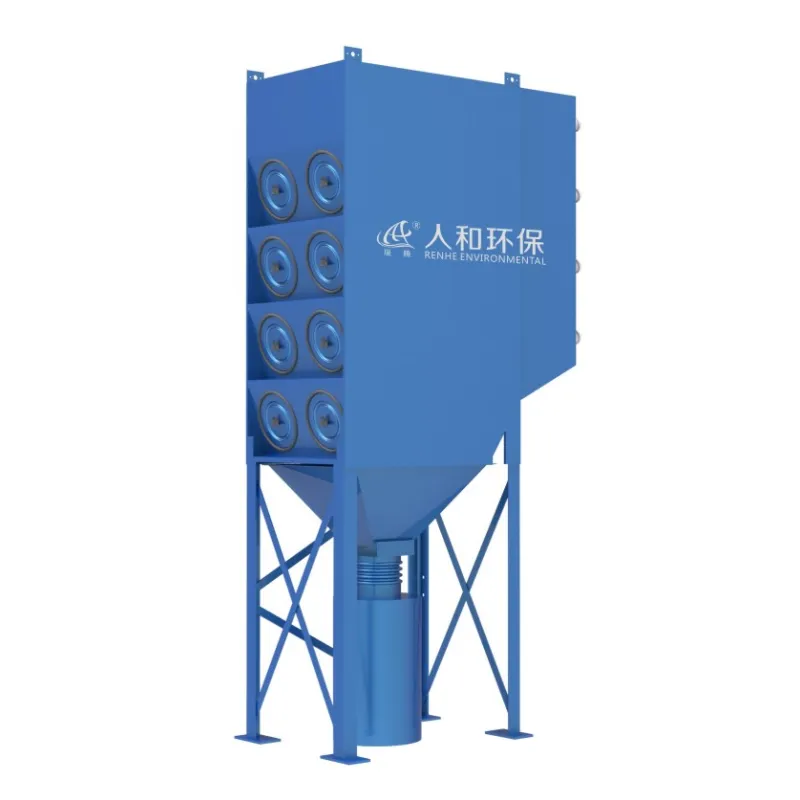
How Pulse Jet Filter Cartridge Enables Fully Automated Online Cleaning
Core cleaning mechanism: Compressed-air pulse-induced shockwave dislodges dust without stopping operation
The pulse jet filter cartridge operates on a precisely timed pneumatic principle. A short burst of compressed air—typically under 0.1 seconds—is fired from a nozzle into the core of the cartridge, generating a high-energy shockwave that travels the full length of the filter media. This causes the media to flex radially by up to 15–20% before snapping back, creating instantaneous mechanical vibration. Combined with a brief reverse airflow, this dual-action force fractures and shears off the dust cake, allowing particulate to fall by gravity into the collection hopper. Critically, this entire process occurs while the system remains online and fully operational—no airflow interruption is required. The synergy of mechanical impulse and reverse shear makes pulse jet cartridges uniquely effective for fine, cohesive, or high-concentration dusts that rapidly blind conventional filters.
Online vs offline cleaning: Real-time regeneration eliminates process shutdowns and manual intervention
Unlike traditional dust collectors that rely on offline cleaning—halting filtration for manual shaking or reverse-air cycles—the pulse jet system regenerates filters in real time while actively filtering. A single pulse can reduce residual pressure drop by 92–95%, restoring near-original airflow capacity instantly (Zhang, 2023). Cleaning is triggered automatically either by differential pressure thresholds or programmable timers—eliminating reliance on operator judgment or scheduled shutdowns. This shift transforms filter maintenance from a labor-intensive, hazard-prone task into a silent, background process. Workers are no longer exposed to dusty environments during cleaning, and production continuity is preserved across shifts and campaigns.
Reduction in Manual Maintenance Labor and Operational Downtime
Labor savings: Up to 70% fewer maintenance hours versus traditional knock-down or reverse-air systems
Pulse jet automation removes the need for manual filter cleaning entirely. Conventional knock-down or reverse-air systems require operators to stop production, open housings, and physically agitate media—a time-consuming, ergonomically taxing process. With pulse jet cartridges, regeneration occurs automatically and online, reducing direct maintenance labor by up to 70%. For a medium-sized facility operating three dust collectors, this translates to over 500 reclaimed labor hours annually—time that can be redirected toward value-added tasks. The elimination of physical handling also reduces risk of media damage and repetitive-strain injuries, while demand-based pulsing prevents wasteful overuse of compressed air. The result is a leaner, safer, and more predictable maintenance footprint.
Maintenance cycle extension: From weekly manual cleaning to quarterly cartridge inspections
Manual cleaning forces rigid, calendar-based interventions—often weekly—regardless of actual filter condition. Pulse jet cartridges sustain stable differential pressure for months, shifting maintenance from reactive to condition-based. Technicians now perform quarterly inspections focused on verifying cartridge integrity, pulse valve function, and controller calibration—not routine cleaning. This reduces exposure to hazardous dust environments and eliminates unnecessary media stress from repeated brushing or shaking. Predictive insights—such as tracking gradual pressure-drop trends—enable precise scheduling of cartridge replacements during planned maintenance windows. The outcome is fewer unscheduled outages, lower spare-part inventory, and a maintenance rhythm aligned with true filter life rather than arbitrary schedules.
Sustained Filtration Performance and Longevity with Pulse Jet Filter Cartridge
99.97% efficiency (MERV-15) maintained over 12 months—proven in industrial field studies
Industrial field studies confirm that pulse jet filter cartridges consistently deliver 99.97% particle capture efficiency at MERV-15 for 12 consecutive months—even under sustained high-dust loading. Unlike mechanically shaken units that suffer “sawtooth” efficiency losses due to progressive blinding, pulse jet systems prevent deep cake formation through timely, low-impact cleaning. Because each pulse responds to real-time differential pressure, energy delivery is optimized: enough to release dust, but not so much as to compromise the fine-fiber structure. This consistency ensures ongoing compliance with emission standards, protects downstream equipment, and maintains indoor air quality—without operator-dependent cleaning that often degrades performance over time.
Optimized pulse jet pressure extends cartridge service life by 2.3× versus fixed-high-pressure setups
Field data from multi-shift operations demonstrate that adaptive pulse pressure control—adjusting energy based on actual filter loading—extends cartridge service life by 2.3× compared to fixed, high-pressure cleaning. Rigid high-pressure systems frequently over-clean, causing micro-fractures in the media substrate and premature failure. In contrast, demand-based logic delivers only the minimal energy required to dislodge the current dust layer, preserving structural integrity. When paired with robustly engineered cartridges—already shown to last 50% longer than standard alternatives—the cumulative effect is transformative: fewer change-outs, reduced waste, lower total cost of ownership, and enhanced system reliability. Operators gain predictability; maintenance teams gain flexibility; and uptime becomes the default—not the exception.
FAQ
What is the key advantage of pulse jet filter cartridges over traditional systems?
Pulse jet filter cartridges provide fully automated real-time cleaning without requiring system shutdown, unlike traditional offline cleaning systems.
How does the pulse jet cleaning mechanism affect dust removal?
The compressed-air pulse creates mechanical vibrations and reverse airflow forces, dislodging particulate matter while maintaining filtration performance.
What maintenance savings can be expected with pulse jet systems?
Facilities can save up to 70% of maintenance labor hours, reduce operational downtime, and shift to quarterly cartridge inspections instead of weekly manual cleaning.
How long is the filtration efficiency maintained?
Pulse jet cartridges maintain 99.97% efficiency (MERV-15) for 12 months, even under high-dust conditions.
How does adaptive pulse pressure improve cartridge life?
Adaptive pulse pressure avoids over-cleaning, reducing micro-fractures and extending cartridge service life by 2.3× compared to fixed-pressure setups.