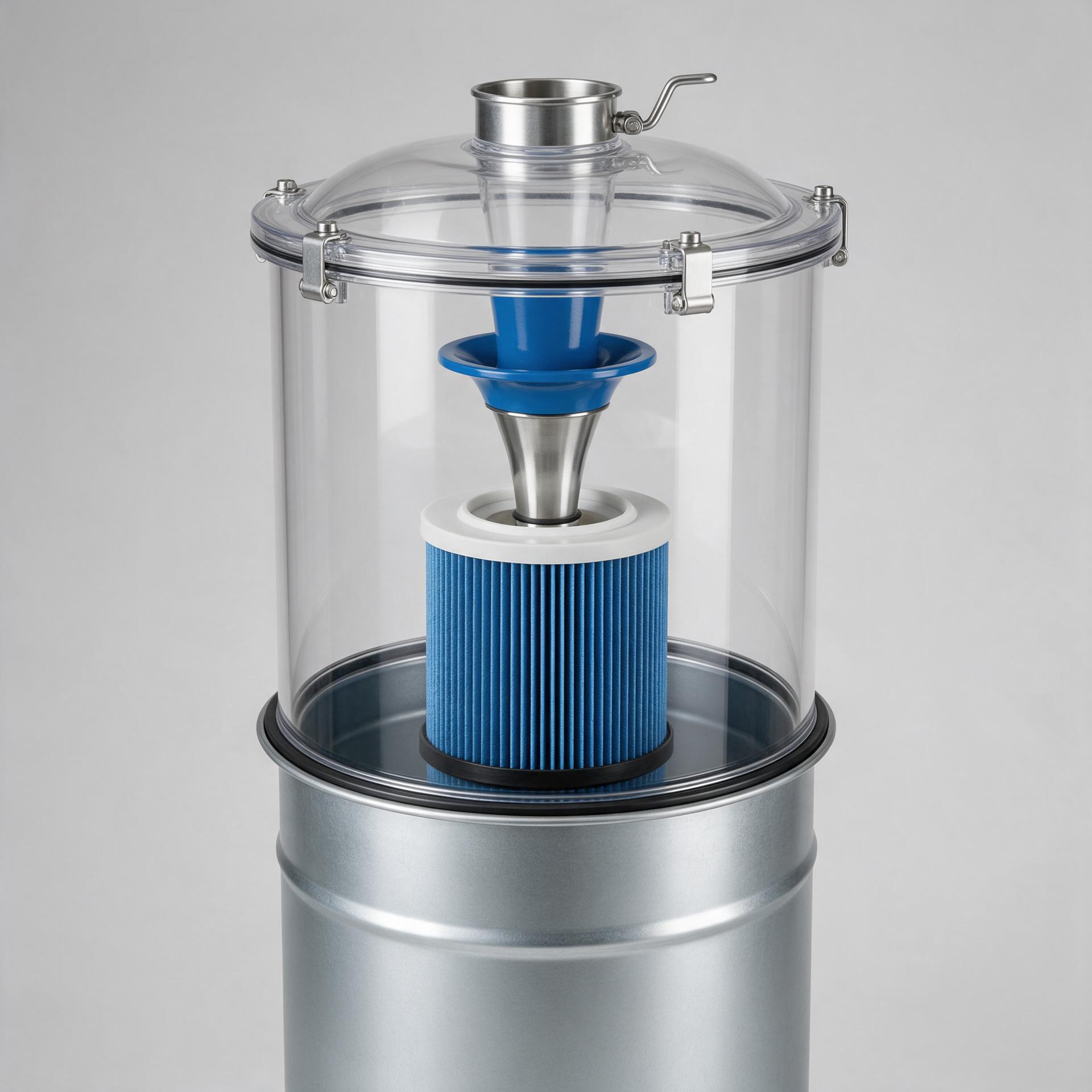
When a cartridge dust collector loses suction after only a few weeks, the filter media is often blamed first. In many plants the real cause sits above the filter: the Venturi tube, a short shaped throat fitted at the top of each element. This component is central to pulse cleaning, because it turns a brief burst of compressed air into a controlled wave that travels down the pleats. Knowing what the tube does helps buyers understand why two units with the same filter area behave differently. A cartridge dust collector that cannot clean itself will always show a rising pressure drop, and extra fan power never fixes that. This guide explains the mechanism in plain engineering terms, using the RH XLC II horizontal cartridge collector as a reference point.
In a cartridge dust collector the Venturi tube is mounted at the clean-air end of every element. Its narrow throat faces the blow pipe, while its wider mouth opens into the interior. During pulse cleaning, compressed air is released for a fraction of a second through a valve above the tube. The shaped throat encourages the jet to draw in surrounding clean air as it passes, a principle known as entrainment. The result is a larger, more even pulse than the nozzle alone could deliver. Because the pulse entering the element is amplified and spread, cleaning efficiency across the full pleat depth improves. This is why the Venturi tube is treated as part of the cleaning system rather than a simple spacer.
Pulse cleaning works by sending a reverse wave of air from the clean side into the dirty side of the media. In a cartridge dust collector the dust layer on the outside of the pleats cracks and falls away when that wave passes. The Venturi tube shapes the wave so that the top, middle and bottom of the element receive a similar impulse. Without that shaping, air would concentrate near the open end and leave the far pleats lightly cleaned. Over many cycles the difference appears as a pressure drop that never fully returns to its starting value. Good cleaning efficiency therefore depends on air distribution as much as on the media itself. Buyers comparing a cartridge dust collector should ask how the pulse is delivered, not only how many elements are installed.
Pressure drop is the practical signal that tells an operator whether cleaning is working. In the RH XLC II unit resistance is described in three stages: an initial 120 to 250 Pa, a working range of 500 to 700 Pa, and a terminal 1000 to 1250 Pa. Those numbers describe a healthy cartridge dust collector, but they only hold if pulse cleaning restores the media between cycles. A poorly shaped throat produces a sharp local jet that cleans one band of pleats while leaving the rest loaded. The measured pressure drop then climbs faster than expected, and the terminal figure is reached early. Attention to the Venturi tube therefore protects both media life and the cleaning efficiency that the whole design promises.
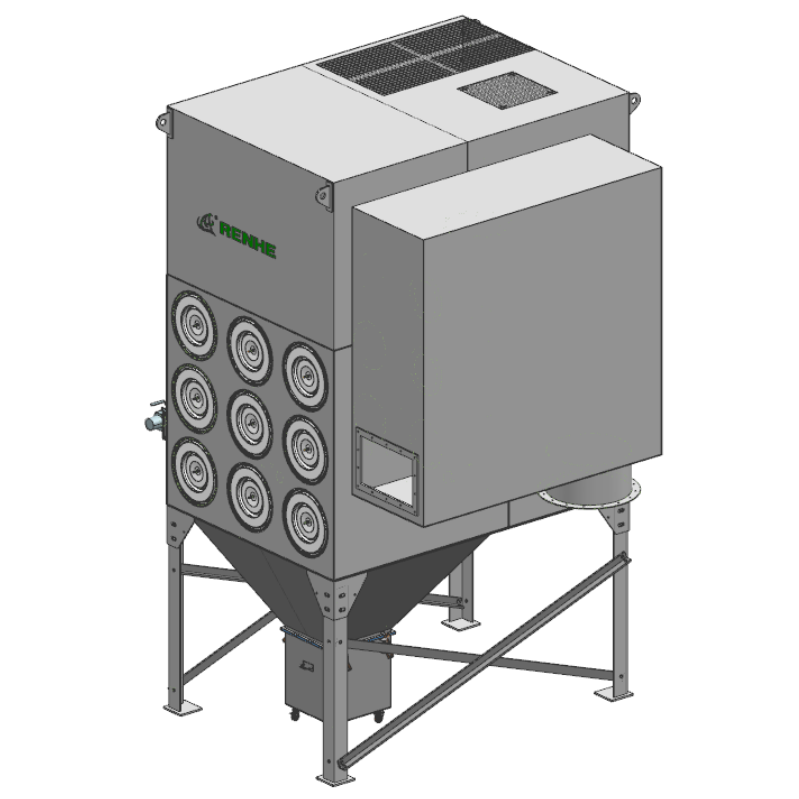
Field experience shows that small features around the Venturi tube affect maintenance more than buyers expect. The RH XLC II uses a fifteen degree inclined drawer arrangement, so elements slide out from the clean side and the person changing them does not reach into dirty air. An anti abrasion baffle at the dirty-air inlet stops incoming particles from striking the media directly, which preserves the pleats that the tube is trying to clean. Inside the cabinet there are no transmission parts to jam, and modular construction allows larger units to be assembled from standard sections. For a cartridge dust collector handling dry, free flowing dust at low inlet concentration, this combination keeps pressure drop predictable. These are specification details worth reviewing before purchase, because they govern how long cleaning efficiency is sustained.
A useful way to see the Venturi tube in context is to follow an anonymous foundry application. A casting shop with a constant sand drenching station routed its dusty air through a hood, a fan and a cartridge dust collector, then through a second high efficiency stage before returning clean air to the room. The plant reported capture above ninety eight percent and discharge below one milligram per cubic metre. That result depended on a stable pressure drop across the collector, which in turn depended on pulse cleaning reaching every pleat. Jiangsu Renhe supplied the filtration stage in that project, and the case shows why the small component above each element deserves attention. When the Venturi tube is well matched, the cartridge dust collector keeps its cleaning efficiency through long shifts and the downstream stage is not overloaded.
Question one: What does the Venturi tube actually do in a cartridge dust collector?
Answer: It shapes the short compressed air pulse so that more air is entrained and spread down the pleats. That makes pulse cleaning more even and helps keep pressure drop stable over time.
Question two: Can I raise cleaning efficiency by increasing compressed air pressure?
Answer: More pressure is not a substitute for a matched Venturi tube. Excess pressure can damage media and still clean unevenly. Review the whole pulse path and confirm the specification of the cartridge dust collector first.
Question three: How do I know whether the tube or the filter is at fault?
Answer: Track pressure drop before and after a pulse. If resistance does not fall, inspect the pulse delivery and throat before assuming the element is spent. Verify test documents and supplier guidance as needed.
 Hot News
2026-11-22
2026-11-22
2026-11-22
2026-11-22
2026-11-22
2026-11-22
Renhe focuses on air filter cartridge, gas turbine air filter, Pleated Filter Media, industrial dust, Our main products have been recognized as high-tech products in Jiangsu Province, famous trademarks in Wuxi City, and CE certification.
NO. 31 Xingyuan Road, Jiefang Industrial Park, Gushan Town, Jiangyin City, Jiangsu Province, China (214414)
Copyright © 2024 Jiangsu Renhe Environmental Equipments Co., Ltd Privacy Policy
 EN